
The Low-Down On “Functional Movement”
The term “functional movement” has been QUITE the buzzword lately…am I right?
But what IS functional movement, exactly?
Surely…all training is “functional,” isn’t it? – kind of…
To me, functional movements are based on real-life biomechanics and movements we perform in our everyday lives. If we can translate what we’re doing in the gym to real-life scenarios, then activities of daily living become much easier and more efficient.
Typically, functional movements include bodyweight or free weights, rather than machines - you’re moving forwards/backwards, side/side, and rotationally. You’re also moving multiple joints at once (think compound exercises, like a squat)....rather than isolation exercises (like a bicep curl).
Should I avoid isolation exercises altogether?
No…not necessarily. Depends on what your strength training goal is. If you’re a bodybuilder? Bicep curls, on their own, are GREAT! If you want to train your body for real-life activities and range of motion, they’re not going to be AS high on the to-do list.
What are the benefits of functional movements?
Rather than focusing on maximum #strengthgains and bulking up, functional movements will help you build:
Mobility
Power
Speed
Strength
Coordination
Think about it. In the real world, you’re not relying on machines to support your body. Which means….it is hugely beneficial to work on things like BALANCE, in order to reduce your risk of injury.
Who should include functional movements in their training program?
Easy. Everyone. And honestly? – it’s suited for ALL ages and abilities. Any movement can be altered via tempo, reps or resistance.
If you’re someone who sits at a desk all day, however….I’m going to go ahead and say: functional movements are ESSENTIAL to your training program. You need to focus on developing a strong posture, as well as healthy hip/shoulder mobility.
What kind of exercises are “functional?”
If you’re looking to get started in a resistance training program, or maybe you’re currently following one, I would consider including these 5 movement patterns in your programming:
SQUAT- any knee dominant exercise that requires adequate flexion/extension at the knee joint ie. goblet squats, barbell back squats, barbell front squats etc. We use this squat pattern when we go to sit down in a chair, on the couch or even on the toilet🚽.
HINGE- any hip dominant exercise that requires adequate flexion/extension at the hips ie. deadlifts, RDLs, kettlebell swings etc. We use this hinge pattern anytime we go to bend over or pick something up off the ground.
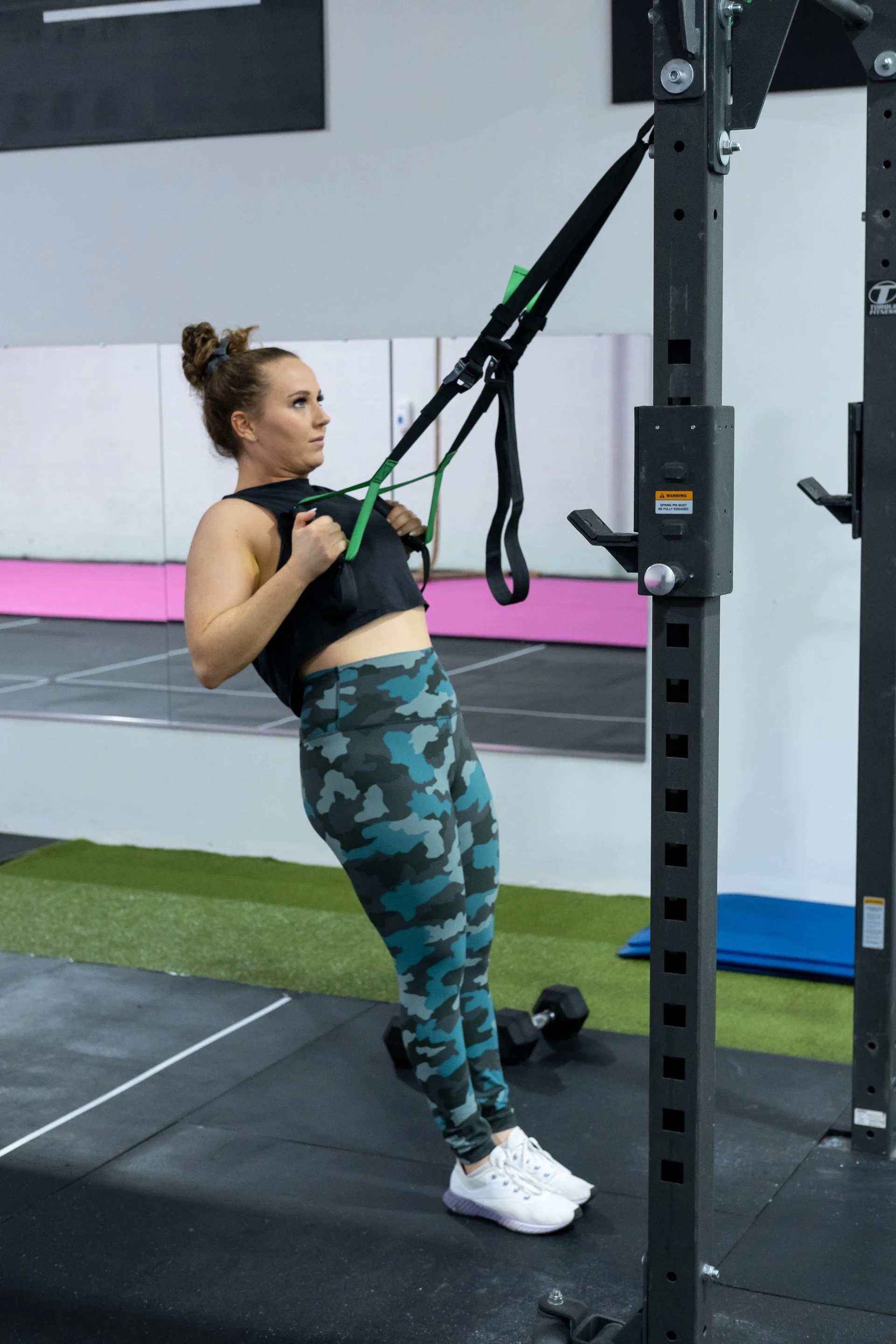
PULL- any exercise that brings the weight closer towards the midline of your body horizontally or vertically ie. dumbbell bent over row, lat pulldowns, TRX rows etc. We use this pull pattern anytime we pull open a door or grab something and bring it closer to us.
PUSH- any exercise that pushes the weight further away from the midline of the body horizontally or vertically ie. barbell bench press, dumbbell overhead shoulder press, push-ups etc. We use this push pattern anytime we want to push ourselves up off the floor or transfer an item to the top shelf or a cabinet.
CARRY - any exercise that simply involves lifting a weight, and walking around with it. With carries, you’re working on everything from top to bottom - lower and upper back, legs, and shoulders, while also hitting the deep stabilizing muscles of the core. We use this pattern when carrying groceries, suitcases, or beach bags!
Go ahead, and share this post with anyone who is interested in strength training! Functional movements will make ALL the difference to your training program, and your life!
Yours in strength,
Mia