Have you ever found yourself stuck in a workout loop that doesn’t really have any goal or direction other than getting in 60 minutes of movement? (Don’t worry, same here!) That’s exactly why I use programming that includes progressive overload for myself and my clients - it’s a simple way to continue measuring your progress.
And today, I’m pulling back the curtain on exactly how each of my programs are structured with progressive overload so that you can see and understand the why behind what you do inside the Strength Space - which also helps you to trust the process a little bit more.
Let’s dive in.
What is Progressive Overload and Why Does it Matter for Women?
Progressive overload is when you’re increasing the demand on your muscles in small, intentional steps so that your body has a reason to adapt and get stronger. You can do this by adding load, changing your reps and sets, adjusting the tempo of an exercise or refining your form.
Without progressive overload, your body can get too comfortable. Which might feel nice… but it doesn’t help you build strength. Structure with this kind of programming is what turns what we do from just working out, to training our bodies to get stronger.
How Does Learn to Lift Build Strength with Progressive Overload?
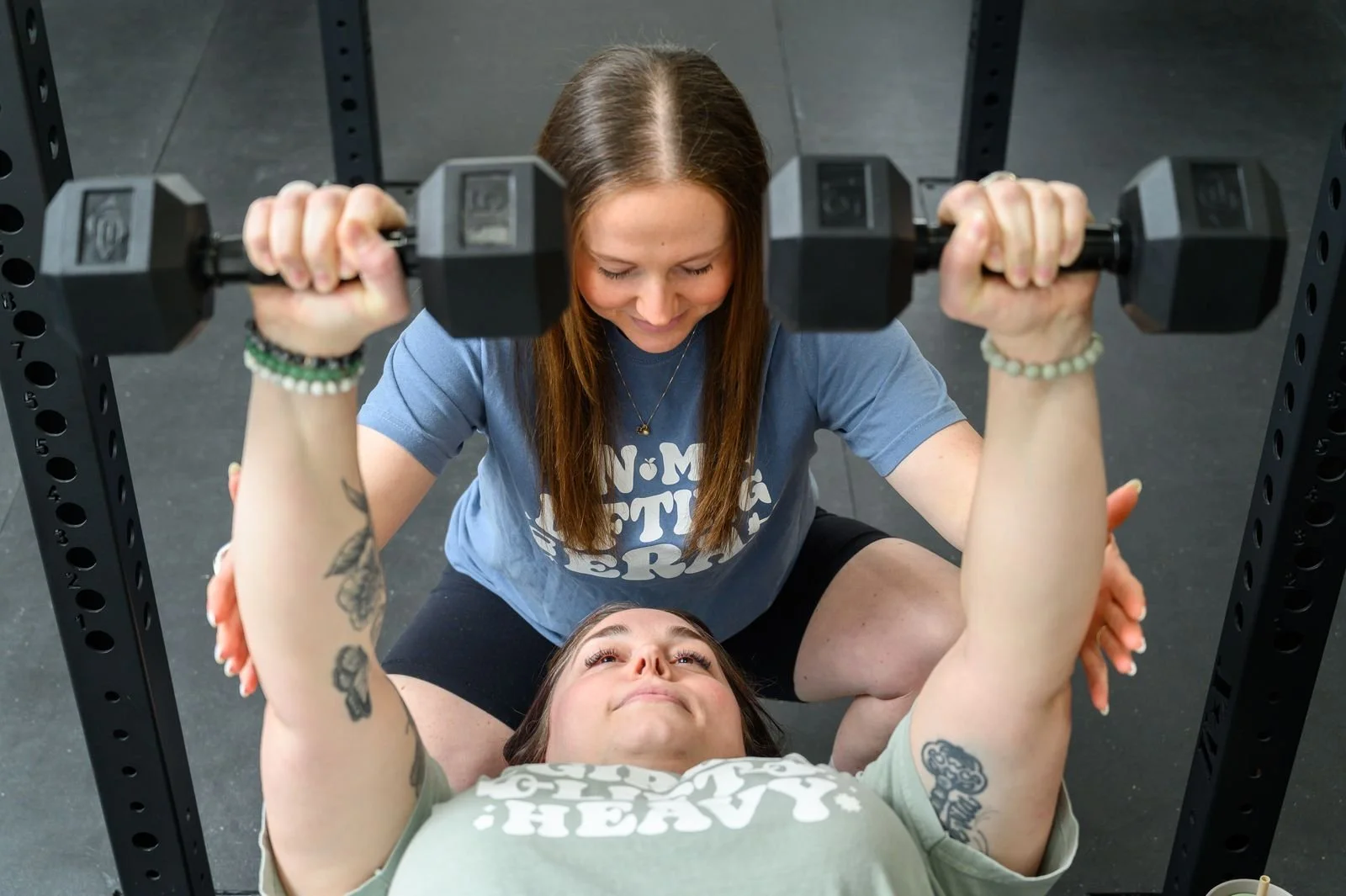
Learn to Lift is my 8-week beginner barbell program and it’s built specifically to teach you the five major movement patterns.
We spend the first five weeks introducing one of these movements into each session.
Week 1: Squat
Week 2: Hinge
Week 3: Horizontal pull (row)
Week 4: Horizontal push
Week 5: Vertical push
Then in weeks 6 to 8, we focus on recapping and refining these movements. Week 6 revisits the squat and hinge, week 7 covers the horizontal row and push, and week 8 brings back the vertical push plus some accessory work.
*Accessory work is a set of supporting exercises that complement your main lifts. They target smaller muscle groups or specific weak spots and help you build balanced strength.
The programming is built this way because learning something new each week keeps it exciting and coming back to it gives you a chance to practice what you’ve learned. By the end of the 8 weeks, these major movements feel more familiar and you can start building upon them.
This is a slow and intentional progression that is the perfect starting point for beginners.
How Does The Lifting Club Use Progressive Overload?
The Lifting Club uses something called mesocycles, which are training blocks that last 5-6 weeks and focus on a specific goal. In each block, we pick two major movement patterns to progressively overload and refine our techniques.
Here’s what a typical block could look like:
Weeks 1 to 5: We stick with the same two main lifts. We start with sets of 8 and work down to sets of 5 then sets of 3 and occasionally test a one-rep max. But each time we’re decreasing reps, our goal is to increase the weight.
Week 6: Deload week. This is a lighter week of training that comes after a block of higher intensity. In The Lifting Club, it gives your central nervous system a little bit of a breather after we’ve been placing higher demands on your body while working up towards those heavier lifts. (Not to be confused with a ‘week off’ - this recovery is all part of the program).
Not every movement needs a one-rep max at the end. We save that for our main lifts, such as the squat, deadlift, bench press and vertical press. Testing those gives a clear, measurable look at how far you’ve come. And there’s nothing better than watching a woman realize she just lifted more than she ever thought she could.
We also tie in primers and finishers that change every week. Our main lifts stay consistent so we can track the progress, but when it comes to these we’re looking for new ways to warm up your body and get ready for the main lifts. Finishers are also great for new ways to challenge yourself and use up whatever you’ve got left in the tank at the end of the session.
This mix gives you the best of both worlds with enough consistency to measure progress in your strength, and enough variety that you never feel like you’re getting bored.

How is 1:1 Coaching Programmed Differently?
1:1 coaching is fully personalised. I build a custom program around your strengths, your weaknesses, your goals, how often you can train and how long you want to spend in the gym.
We usually stay on a program longer since everything is built around one person. Depending on your consistency and progress, you might stay on a program anywhere from four weeks up to 12 weeks, but for most people the sweet spot is about eight weeks.
After that, we do a program update. This could look like swapping out movement patterns or adjusting the volume or intensity. The goal is to keep you progressing. And yes, I do take boredom into account. If you’re dreading your workouts, you won’t want to do them, and the best program is one you actually want to do.
Which Program is Right for You?
The right program depends on where you’re starting and what level of support you want.
If you’re new to lifting or nervous about using a barbell, Learn to Lift gives you the foundations you need, one movement at a time.
If you already know your way around a barbell, The Lifting Club gives you structured blocks and measurable progress.
If you want a plan built around your body, your schedule and your goals, 1:1 coaching is fully tailored to you.
Every program has a plan, and every plan has a purpose.